Roof drains
Drains sit in the low spots of the field and carry water down through the building. Leaves and ice block them first, so they get cleared in spring and fall.
Flat Roofs, Done Right
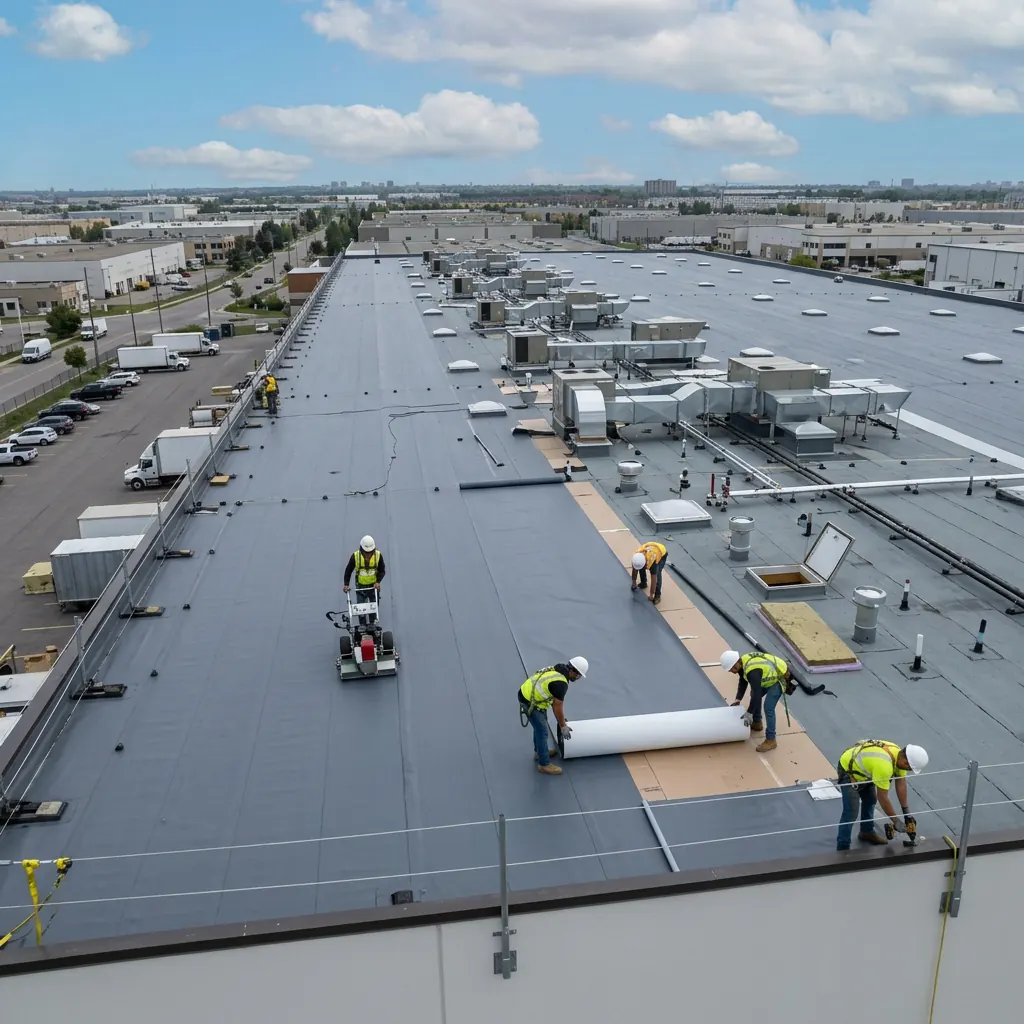
A flat roof is not flat, and it is not simple. It is a system of layers, seams, drains, and flashing that has to move water off a nearly level surface through freeze and thaw. We build and repair EPDM, TPO, PVC, and spray foam roofs that hold up to Rochester winters.
Flat roofs in a cold city
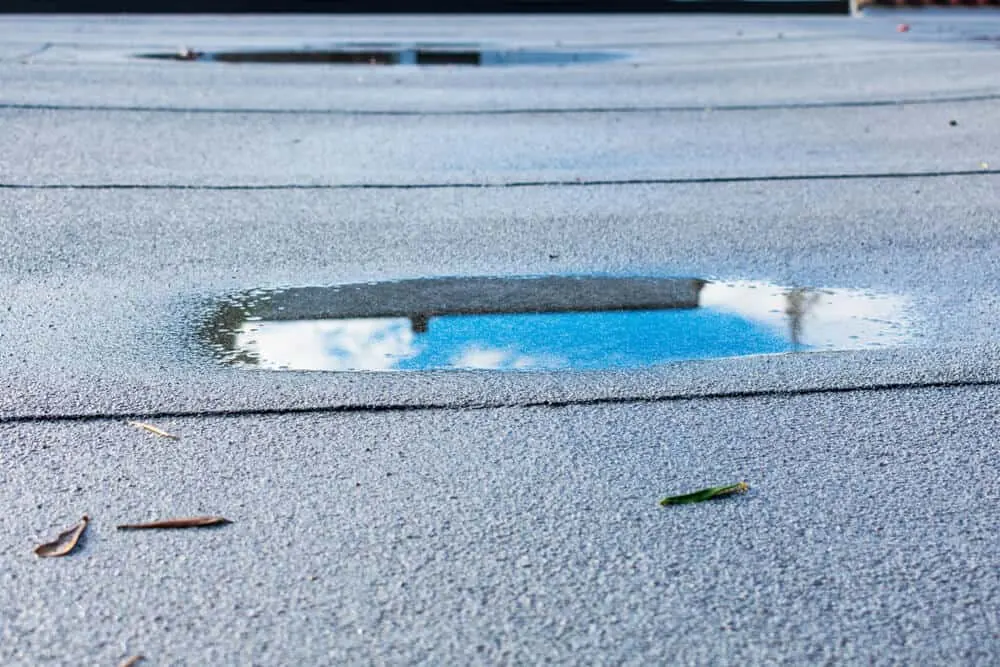
Rochester freeze and thaw is the hardest test a flat roof faces. Water that ponds on the membrane freezes overnight, thaws by midday, and works at the seams a little more with each cycle. Snow sits on a flat roof for weeks, melts from the heat below, and refreezes at the drains. A flat roof here needs seams that hold, drains that stay open, and a membrane that stays flexible in the cold.
A flat roof is built in layers, and each layer has a job. The deck carries the load, the insulation keeps the heat in, the membrane keeps the water out, and the flashing seals the joints where the roof meets a wall, a parapet, or a vent. When one layer fails, the water finds the next one down. Roof inspection in Rochester for a flat roof walks the membrane, checks the seams and the drains, and looks for ponding that stays after a rain.
Flat roofs cover more than warehouses. Porches, additions, and garages across Rochester wear low-slope roofs, and many older city houses have a flat section over the back addition. Commercial roofing in Rochester covers the large flat roofs, and this page covers the systems themselves, from a porch roof to a warehouse.
The layers under your feet
Tap a layer to see what it does and what happens when it fails.
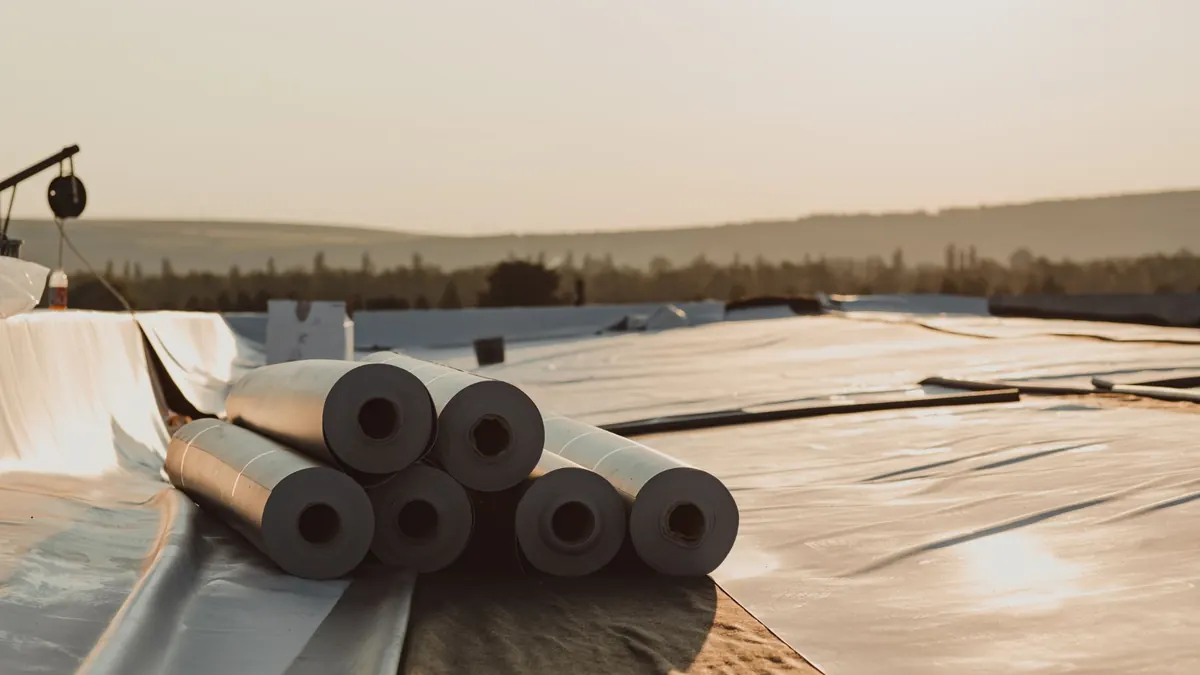
The membrane is the layer you see and the layer that keeps the water out. EPDM is a rubber sheet, TPO and PVC are heat-welded plastic sheets, and spray foam is a seamless coating that goes on as a liquid. Seams are the weak point, and a membrane fails at its seams more often than in the middle of a sheet.
Insulation sits under the membrane and keeps the heat inside the building. Wet insulation loses its value fast, and it stays wet under a membrane that looks sound from above. A flat roof with wet insulation feels spongy underfoot and lets heat escape, and the wet boards underneath it rot quietly.
The deck carries the whole system: the insulation, the membrane, the snow load, and the crew. A deck that is soft or rotted will not hold fasteners, and the membrane lifts in the first strong wind. Before any new membrane goes on, the deck gets walked and checked, and soft boards get swapped.
A flat roof moves water through drains in the field and scuppers at the parapet, and both must stay open. Leaves, ice, and debris block them, and a blocked drain turns a flat roof into a pond. The pond finds every weak seam, and the weight of the water tests the deck underneath.
Four systems, side by side
Four systems cover most flat roofs in Rochester. Each one has its own strengths and its own weak spots.
| System | What it is | Seams | Best when |
|---|---|---|---|
| EPDM | Rubber sheet, black | Glued or taped | A simple, proven rubber roof |
| TPO | White plastic sheet | Heat-welded | A bright roof that reflects summer sun |
| PVC | White plastic sheet, flexible | Heat-welded | Chemical and grease resistance matter |
| Spray foam | Seamless foam coating | None, one continuous coat | A tired roof needs a second life |
Scroll sideways to see the full table.
Water standing on the flat roof days after the rain? Call and get the seams and the drains checked.
Call (585) 868-0065The flat-roof problem to watch
Ponding water is water that stays on a flat roof for days after the rain stops. A little ponding after a storm is normal, since no flat roof drains in minutes. Ponding that stays for two days or more is a problem, because it finds every weak seam, adds weight to the deck, and feeds the freeze and thaw cycle that splits the membrane.
Ponding has three usual causes: a deck that has sagged under the load, drains that are blocked by leaves or ice, or insulation that has gone soft under the membrane and let the surface dip. The fix depends on the cause. A blocked drain gets cleared. A sagging deck gets leveled with tapered insulation that slopes the water toward the drains. Roof repair in Rochester for a flat roof starts with the same question: where does the water sit, and why does it stay?
A second life
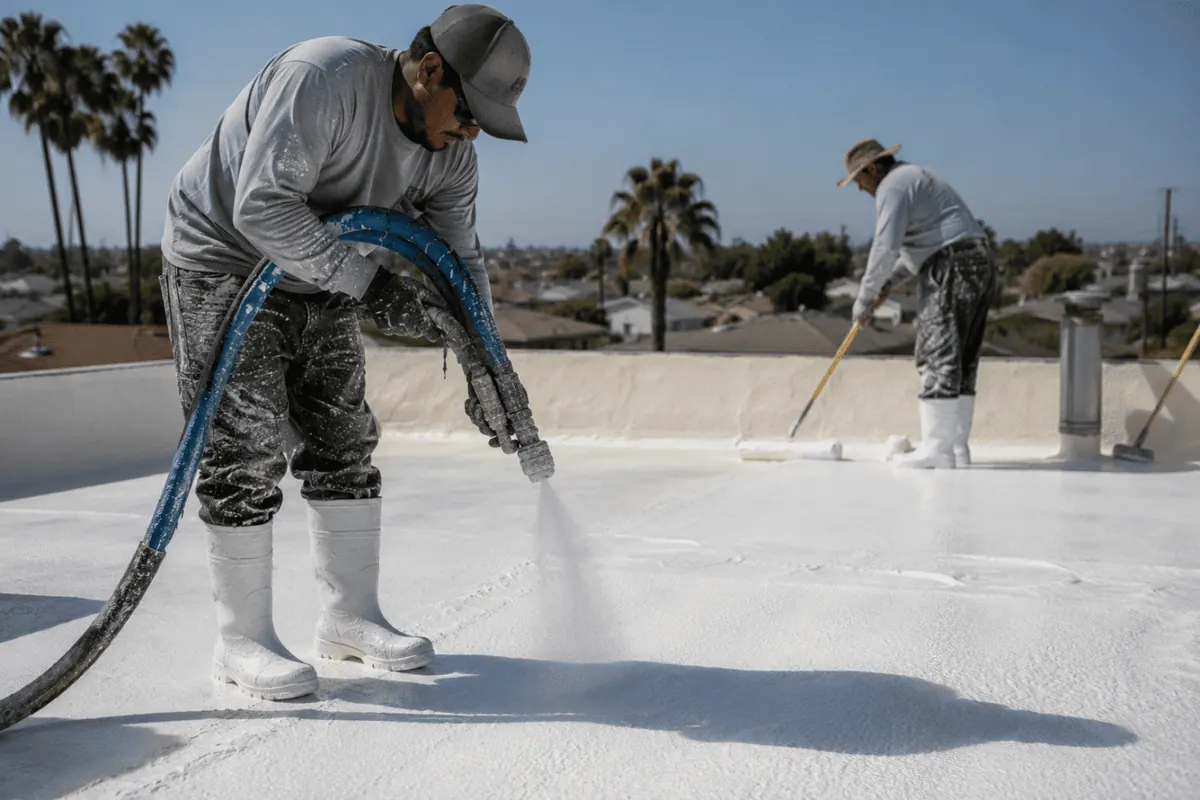
A flat roof that is tired but not broken can get a second life from a coating or a spray foam layer. The old membrane stays in place, the seams get sealed, and a new coat goes over the top, seamless and watertight. Spray foam adds insulation at the same time, since the foam itself insulates, and it fills the low spots where water ponds.
A coating is not a cure for a rotten deck or wet insulation. Before any coating goes on, the roof gets walked, the wet insulation gets marked, and the soft boards get swapped. A coating over wet insulation traps the water inside, and the roof fails from below. When the deck is sound and the insulation is dry, a coating is a sound way to extend the life of a flat roof. And when the roof is done, gutters and gutter guards in Rochester keep the water moving off the eaves instead of back under the membrane.
Where the water goes
A flat roof is a water system. Three parts move the water off, and each one needs a clear path.
Drains sit in the low spots of the field and carry water down through the building. Leaves and ice block them first, so they get cleared in spring and fall.
Scuppers are openings in the parapet wall that let water run off the edge. They are the backup when a drain blocks, and they must stay open.
Overflow drains sit a little higher than the main drains and take over when the main drain cannot keep up. They are the last line before the water ponds deep.
People also ask
Short answers to the flat, foam & single-ply roofing questions that come up most in real conversations.
A well-built flat roof lasts many years, but freeze and thaw shorten that life when seams are weak or drains stay blocked. EPDM, TPO, and PVC age at their own pace, and a coating or foam layer can extend a tired membrane. The inspection reads the seams and the deck, and the report says where the roof stands.
Because the surface is not sloped enough toward the drains, or the drains are blocked. A deck that has sagged under the load lets the surface dip, and wet insulation under the membrane lets it dip further. Tapered insulation re-slopes the surface toward the drains, and clearing the drains keeps the water moving off the roof.
Yes, with limits. Cold membranes are stiff, and snow hides the seams, so a winter repair leans on clearing the drains, sealing the worst seam, and stopping the water until spring. A full membrane repair waits for a dry, warm stretch, when the seams can be welded or glued properly and the roof can be walked safely.
It is a strong choice when the deck is sound and the insulation is dry. Spray foam goes on as a liquid and sets into a seamless coat with no joints for water to find, and it adds insulation. It needs a coat against the sun, and it is not a cure for a rotten deck or wet insulation underneath.
A flat roof that holds water is a flat roof asking for a look. Call and get the seams and the drains read properly.
Call (585) 868-0065Frequently asked questions
There is no single best material, and the right one depends on the roof. EPDM is a proven rubber sheet that stays flexible in the cold. TPO is a bright, heat-welded sheet that reflects summer sun. PVC handles grease and chemicals well. Spray foam gives a seamless coat with no joints. The inspection reads the roof and names the system that fits it.
Look at the seams, the ponding, and the deck. Seams that split open, ponding that stays for days, and decking that feels soft or spongy underfoot all point to a roof near the end of its run. A single seam repair can hold a sound roof together, but wear across the whole membrane means the system is done.
Seams that split, flashing that lifts at the parapet or a vent, drains that block and let the water pond, and punctures from foot traffic or dropped tools. Freeze and thaw work at the seams a little more with each cycle, and ponding water finds every weak spot. The leak usually shows far from the hole, since water runs under the membrane before it drips.
Yes, carefully. A sound flat roof takes foot traffic, but every step tests the seams and the membrane, and a dropped tool can puncture it. Walk on the membrane in soft shoes, stay off the seams, and keep the roof clear of stored materials. When work is needed on the roof, a walkway pad protects the membrane under the traffic.
They need a way for the water to leave, and that is usually a drain or a scupper, not a gutter. A flat roof with a parapet drains through scuppers in the wall, and a flat roof without one drains through internal drains. Gutters come in where the flat roof meets a sloped section, and gutters and gutter guards in Rochester cover that joint.
Keep going
Flat roofs connect to the rest of the building. These services cover the joints.
Large flat roofs on warehouses, offices, and shops get the same systems, at a bigger scale, with a maintenance plan.
Learn more →A flat roof inspection walks the membrane, checks the seams and the drains, and looks for ponding that stays.
Learn more →A split seam or a lifted flashing joint on a flat roof gets repaired at the source, with the membrane around it checked.
Learn more →Built-in slope
A flat roof is never truly flat, and the small slopes built into it are what move water off a surface that has no pitch to help it.
The slope on a flat roof is built, not found. Tapered insulation is laid in a gentle fall toward the drains, so water that lands anywhere on the roof has a downhill path to follow, even where the roof looks level from the ground. The fall is slight, a fraction of what a pitched roof carries, but it is enough, since water only needs a direction, and the tapered layers give it one.
Crickets are the second built slope. A cricket is a small raised wedge set behind a chimney, a vent, or a heating and cooling unit, and it splits the water around the obstacle instead of letting it pond behind it. On a flat roof, anything that sticks up through the surface makes a dam, and the cricket is what keeps the water moving past it, so the membrane behind the unit stays dry instead of sitting under a puddle.
The edge is the third path water takes. Scuppers are openings cut through the parapet wall, and they let water run off the edge of the roof into a downspout or onto the ground below, so a flat roof has more than one way out: the drains take the water in the middle, and the scuppers take it at the edge, and the two together keep a heavy rain from rising against the parapet. When the drains clog with leaves in the fall, the scuppers are the backup, and a look at gutters and downspouts in Rochester covers the path the water takes once it leaves the roof.
Weak points
Seams, flashings, and penetrations are the three places a flat roof opens up, and each one fails in its own way.
A flat roof is made of sheets joined at the seams, and the seams are where the roof opens first. Heat, cold, and foot traffic work at the joints, and a seam that lifts lets water under the membrane, where it spreads unseen until it finds the deck.
Every vent, pipe, and heating and cooling curb is a hole through the membrane, and each one is sealed with a flashing boot or a curb wrap. The seals age in the sun, and a cracked boot around a vent lets rain run straight down the pipe into the building.
The parapet wall caps the edge of the roof, and the metal cap over it keeps water out of the wall itself. When the cap lifts or the mortar behind it cracks, water runs down inside the wall and shows up as a damp patch rooms below the roof.
The three weak points share one habit: they fail quietly. A seam that has lifted a little, a boot that has cracked at the collar, and a cap that has lifted at one end all look sound from the ground, and the water they let in spreads under the membrane before it shows inside. A walk of the roof after each season finds them while the fix is a seam re-welded or a boot swapped, and the walk is the reason a flat roof is checked on a schedule rather than when it leaks.
Foot traffic
A flat roof invites footsteps, since it looks like a floor, but the membrane under your feet is a skin, and it takes foot traffic only in the places built for it.
Service visits are the most common traffic a flat roof sees. Heating and cooling technicians, painters, and anyone who sets a ladder against the parapet all cross the membrane, and each visit leaves scuffs, dropped tools, and the odd screw on the surface. A screw left on the membrane becomes a puncture the next time someone steps on it, so a walkway pad is laid along the path to the units, and the path keeps the traffic on the pads and off the bare membrane.
Furniture and storage are the second load. A flat roof is not a deck, and chairs, planters, and stored boxes press on the membrane and hold water under them, so the roof is kept clear of anything that sits on it for a season. A planter that holds wet soil against the membrane will wear the surface under it, and a box left through the winter freezes to the roof and tears the membrane when it is pulled off in the spring.
Snow is the third load, and it is the heaviest. A flat roof in Rochester holds snow for weeks, and the snow melts from the heat below, refreezes at the drains, and ponds behind the ice it makes. A look at snow removal and ice dam help in Rochester covers how the snow is cleared safely, and the roof itself is checked in the spring for the seams and the flashings that the winter worked on.
Call and get the membrane, the seams, and the drains checked by a roofer who knows flat roofs.