Seamless K-style
One continuous run with no joints except at the corners, formed on site to fit the house. The most common Rochester gutter, and the least likely to leak at a seam.
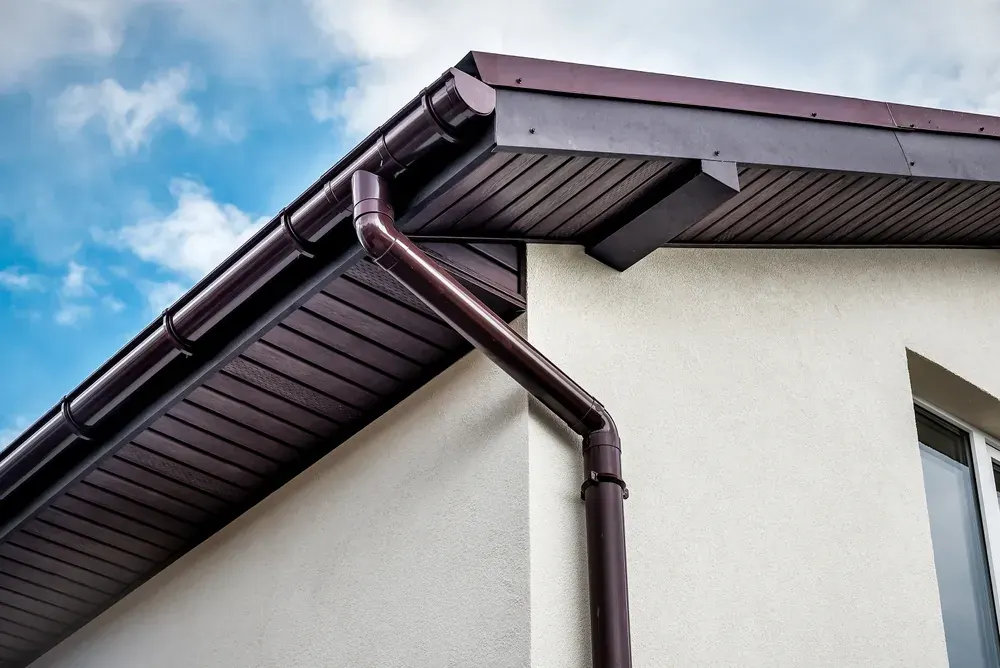
Water Off the Roof, Away From the House
Gutters do more than catch rain. They carry water off the roof, past the fascia, and away from the foundation, and when they clog or sag, the water finds its way back under the shingles and into the house. We fit, repair, guard, and clean gutters that keep Rochester water moving.

More than a trough
A gutter is the last stop for roof water, and the first line of defense for the house below it. It catches the water running off the slope, carries it along the eave, and sends it down the downspout and away from the foundation. When the gutter clogs, sags, or leaks at a seam, the water goes where it should not: back under the shingles, behind the fascia, and down the wall to the foundation.
Rochester gutters work hard. Spring rain, summer storms, autumn leaves, and winter ice all test them in turn, and a gutter that is sound in July can be torn off its hangers by sliding snow in January. Roof repair in Rochester often starts at the gutter, since granules and shingle bits in the trough say the roof above is wearing thin. And attic ventilation and insulation in Rochester matter here too, since a warm attic feeds the ice dams that form at the eaves and tear at the gutters.
Shapes and systems
Six gutter types cover most Rochester houses, and each one has its own look and its own weak spots.
One continuous run with no joints except at the corners, formed on site to fit the house. The most common Rochester gutter, and the least likely to leak at a seam.
Pre-cut lengths joined at the seams. Easier to fit on a tight job, but every seam is a place that can leak over time.
A rounded trough that suits older and historic houses. It sheds leaves well, but it carries less water than a K-style of the same size.
A square trough built into the eave, common on older city houses. It holds a lot of water and hides inside the roofline.
A long-lived metal that weathers to a green patina. It suits historic houses and outlasts painted steel, but it needs a crew that knows how to solder it.
Light, rust-proof, and the most common gutter metal in Rochester. It dents under a ladder or sliding snow, but it does not rust through.
Guards, compared honestly
Guards keep leaves out, but no guard keeps everything out forever. Here is how the four common types compare.
| Guard type | How it works | Keeps out | Watch out for |
|---|---|---|---|
| Mesh screen | Fine metal mesh over the trough | Leaves and most debris | Fine grit and seeds can sit on top |
| Reverse curve | Curved cover, water follows the curve in | Leaves and twigs | Heavy rain can overshoot the curve |
| Foam insert | Porous foam fills the trough | Leaves and large debris | Needs swapping when it clogs or rots |
| Brush guard | Bristles fill the trough | Large leaves | Small debris settles between bristles |
Scroll sideways to see the full table.
Gutters overflowing every time it rains? Call and get them cleared, checked, and guarded.
Call (585) 868-0065Gutter cleaning
Gutter cleaning is the job that keeps the whole water system working. Leaves, twigs, grit, and shingle granules settle in the trough, and once the trough is full, the water has nowhere to go but over the edge and back under the eaves. A cleaning clears the trough by hand, flushes the downspouts with water, and checks that the water runs clear from the roof to the ground.
Rochester gutters need cleaning twice a year at least: once in late spring, after the seeds and blossoms fall, and once in late fall, after the leaves come down. Houses under big trees need it more often, and a gutter with a guard still needs a look, since fine grit and seeds settle on top of the guard and wash into the trough. Roof maintenance in Rochester folds gutter cleaning into the regular walk of the roof, so the troughs are cleared before the snow arrives.
The trough gets cleared by hand, the downspouts get flushed until the water runs clear, the hangers get checked for sag, and the seams get checked for leaks. When a downspout is blocked solid, it comes apart and gets cleared from the inside. A cleaning also shows what the roof is doing, since granules and shingle bits in the trough say the shingles above are wearing thin.


Gutters and ice dams
A gutter full of leaves and ice is the start of an ice dam. Meltwater runs off the roof, hits the clogged gutter, and has nowhere to go, so it backs up under the shingles and into the house. The dam grows with each melt and freeze, and the water behind it finds every weak seam at the eave.
Clean gutters help, but they do not stop ice dams on their own. The dam forms because the attic is warm and melts the snow from below, and the lasting answer sits in the attic, not in the gutter. Snow removal and ice dam prevention in Rochester covers the safe way to clear a dam, and the attic work that keeps it from coming back. And where the downspout water goes matters too: the City of Rochester asks homeowners to keep stormwater out of the sanitary sewer, so downspouts should carry water to the yard, not into a drain that leads to the sewer.
Downspouts and drainage
A downspout is only as good as where it ends. Water that pours out at the foundation soaks the soil, seeps into the basement, and heaves the walkway in winter. A downspout should carry the water at least a few feet from the house, onto a splash block or into a buried line that runs to daylight. A splash block is a simple trough that spreads the water across the yard, and a buried line keeps the water off the walkway in winter.
Underground lines need a look too, since leaves and grit wash down the spout and settle in the line. A line that is blocked solid sends the water back up the spout and over the gutter. When a downspout is disconnected in winter, the water should run onto the yard, not onto the walkway where it freezes into a sheet of ice.
People also ask
Short answers to the gutters & gutter guards questions that come up most in real conversations.
They work well for leaves and twigs, which are the main thing that clogs a Rochester gutter. No guard keeps everything out forever, and fine grit, seeds, and shingle granules still wash into the trough, so a guarded gutter still needs a look each year. The guard buys time between cleanings, it does not end them.
Twice a year: late spring, after the seeds and blossoms fall, and late fall, after the leaves come down. Houses under trees need it more often, and a gutter with a guard needs a check, since debris settles on the guard. A cleaning before winter matters most, since a clogged gutter feeds the ice dams that form at the eaves.
Yes. A clogged gutter holds water against the eave, and the water backs up under the shingles and into the fascia and the decking. In winter, the clogged gutter feeds an ice dam, and the dam pushes meltwater further under the roof. The fascia rots first, then the decking, and the repair grows from the gutter to the roof.
Leaves in the trough, water over the edge, and winter on the way? Call and get the gutters cleared before the snow.
Call (585) 868-0065Frequently asked questions
When the trough is rusted through, the seams leak, or the hangers have pulled loose. A leaking seam or a sagging section can be fixed in place, but a gutter that leaks in several places and sags along its length is telling you the system is done. A roof replacement is also a good time to fit new gutters, since the drip edge and fascia are open.
Most Rochester houses wear five-inch K-style gutters, which carry the rain from an average roof slope. A large or steep roof, or a roof with long runs to one downspout, needs six-inch gutters to keep the water from overshooting the trough in a hard rain. The downspouts matter as much as the trough, since a small spout chokes the flow no matter how big the gutter is.
No. Guards keep leaves out of the trough, but an ice dam forms because the attic is warm and melts the snow from below, and the meltwater refreezes at the cold eave. A guarded gutter can still freeze solid and feed a dam. The lasting answer is in the attic: even insulation and clear airflow from the soffit to the ridge, so the roof deck stays cold.
Either the trough is clogged, the downspout is blocked, or the gutter is too small for the roof feeding it. A clogged trough overflows at the lowest point, a blocked downspout overflows along the whole run, and an undersized gutter overshoots in a hard rain even when it is clean. A cleaning and a flush show which one it is, and the fix follows from the cause.
Yes, with limits. Cold aluminum is stiff and can crack if it is bent sharply, so winter installs are done with care and often in shorter runs. Snow and ice on the eave make ladder work slow, and the sealant needs a dry surface to set. Most gutter work waits for a dry stretch, and a cleaning before winter matters more than a new install during it.
Watch the water in a hard rain. A downspout that is blocked will overflow at the top, spill from the seams, or stay dry while the trough fills. A downspout that is clear will run a steady stream at the bottom. A hose run down from the top clears most blocks, and a downspout that stays blocked comes apart and gets cleared from the inside.
Onto the yard, or into a buried line that runs to daylight well away from the house. Water that pours out at the foundation soaks the soil and seeps into the basement, and in winter it freezes on the walkway. A splash block spreads the water across the yard, and a buried line keeps it off the walkway entirely.
Keep going
Gutters are the last stop for roof water. These services cover the roof above them.
Granules in the trough say the shingles above are thinning. A repair traces the wear to its source.
Learn more →When gutters feed an ice dam, the lasting answer sits in the attic, not in the trough.
Learn more →Water that gets behind the gutter rots the fascia first. See how fascia and soffit are repaired and replaced.
Learn more →Right size, right run
A gutter is sized for the roof it serves, and the size that works on a small porch fails on a large steep slope, so the roof decides the gutter, not the other way around.
The roof area is the first measure. A large roof catches more rain than a small one, and a steep roof sheds it faster, so a big steep slope sends a rush of water at the gutter in the first minutes of a storm, while a small gentle slope sends a slower stream. The gutter and the downspout are sized together for that rush, since a gutter that can hold the water is no help when the downspout cannot carry it away.
Valleys are the second measure. A valley gathers the water from two slopes and pours it into one stretch of gutter, so the run under a valley takes more water than any other run on the house, and it is the run that overflows first in a hard rain. A second downspout on that run, or a wider gutter along it, spreads the load, and the splash at the valley is the sign that the run is taking more than it can carry.
| Roof shape | What the gutter faces | What helps |
|---|---|---|
| Large, steep slope | A fast rush of water in the first minutes of a storm | A wider gutter and a downspout sized for the rush |
| Valley above the run | Water from two slopes pouring into one stretch | A second downspout on the valley run |
| Long, straight run | Water that has to travel far before it finds a downspout | Downspouts at both ends of the run |
| Roof under maple trees | Seeds and leaves that fill the trough each fall | Guards that keep the seeds out, and a fall cleaning |
Spring thaw is the third measure, and it is the one Rochester adds. Snow that has sat on the roof for weeks melts all at once on a warm March day, and the meltwater runs into gutters that may still hold ice at the bottom. A gutter that drains slowly in the thaw backs up behind the ice, and the water finds the fascia instead, so the fall cleaning that clears the leaves matters as much in the spring as it does in the fall.
Water in the wrong place
Gutter water that leaves in the wrong place damages the house in three places: the fascia, the siding, and the basement.
Water that runs behind the gutter soaks the fascia board it hangs from, and the board softens and rots from the back. The gutter then pulls away from the house, and the rot spreads along the eave.
Water that spills over the gutter runs down the siding, and the streaks it leaves are the first sign. The siding itself may survive, but the water finds the joints and the trim, and the damp behind the siding feeds rot in the sheathing.
Water that pours out at the foundation soaks the soil against the wall, and the soil pushes the water through the cracks and the joints into the basement. The damp shows as a wet strip along the base of the wall after a hard rain.
The three paths share one start: water that leaves the gutter in the wrong place. A gutter that overflows at the valley, a downspout that spills at the seams, and a splash block that points at the wall all put water where the house is not built to take it, and the damage shows up far from the gutter itself, on the fascia, on the siding, or on the basement wall. A look at fascia and soffit in Rochester covers the boards the gutter hangs from, and the fix starts with the gutter, not with the wall it damaged.
What each guard stops
A guard is judged by what it keeps out of the trough, and the three common types each stop a different kind of debris, so the trees over your roof decide which one fits.
Mesh guards are the fine screen of the three. A fine mesh keeps out maple seeds, pine needles, and the small bits that wash into the trough, and it lets the rain through in a sheet, but the mesh itself can clog with pollen and fine grit, so it asks for a brush across the top each fall. Mesh suits a roof under maples and pines, where the debris is small and constant through the season.
Perforated covers are the solid lid with holes punched through it. The lid sheds leaves and twigs off the edge, and the rain runs through the holes into the trough, but the holes are small, and a heavy downpour can sheet over the top of the lid and spill past the gutter. Perforated covers suit a roof under oaks and large trees, where the debris is big and the rain is steady rather than sudden.
Foam inserts sit inside the trough and fill it with a porous block that lets water through and holds debris on top. The block keeps the trough clear, but it holds damp against the gutter through the winter, and it needs lifting out and cleaning when the debris builds up on its surface. Foam suits a short run under light trees, where the debris is light and the trough is easy to reach, and a roof maintenance visit in Rochester includes the gutters, so the guard and the trough are checked together each season.
Call and get the gutters cleared, checked, and guarded before the next rain tests them.